A Feather and a Fork by Crystal Wahpepah is one of the best cookbooks of Spring 2026 (according to lists found at Bon Appétit and Forbes). Keep reading but this might be the best book I have reviewed in this cycle.
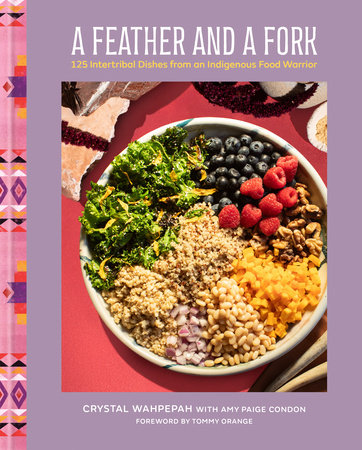
About the book:
From an acclaimed Indigenous chef comes an extraordinary cookbook that weaves powerful storytelling with 125 intertribal recipes to heal our bodies and restore our foodways—featuring a foreword by bestselling novelist and fellow Oaklandian Tommy Orange.
Chef Crystal Wahpepah has used her growing platform to tell the little-known history of Oakland’s tight-knit Native American communities, which were relocated from reservations across the country to the San Francisco Bay area in the 1950s. Crystal’s powerful message to reconnect to our foodways and transform generational trauma into strength as well as her healing dishes have been seen on Food Network’s Chopped and Beating Bobby Flay.
The rise of corporate agriculture around the world relies on singular and often genetically modified monocultures plus lots of chemicals and soil additives to produce massive crop yields. And while this approach may economically make sense on paper to feed multitudes at the lowest price point possible, it has harmed our physical health, emotional well-being, and the very creation that supports life. This truth applies not just to Indigenous people, who have been harmed by the federal commodified foods program, but to all of us who have come to rely on cheap and easy processed foods to feed our families. We no longer get the nutrients we need from our food and spend lots of money on supplementing our diets. We develop chronic diseases that can be avoided and even cured through eating habits.
Eat with the seasons, cure your disconnection with the land, and cook colorful, delicious food rooted in the oldest traditions including:
- Three Sisters Veggie Bowls
- Sweet Blue Cornbread with Huckleberry Compote
- Indigenous Popcorn Balls with Edible Flowers
- Strawberry-Sumac Salad with Maple-Sage Vinaigrette
- Bison Roast with Chokeberry Rub
- Smoked Salmon Dip with Red Chilies and Chips
- Acorn Muffins, and much more
A Feather and a Fork includes 125 recipes developed in collaboration with ethnobotanist and food sovereignty advocate Linda Black Elk to explore the environmental, spiritual, physical, and social benefits of each dish as well as raise awareness of and support for indigenous food producers who are preserving heirloom foods and traditions. (from Penguin Random House)
About the author:
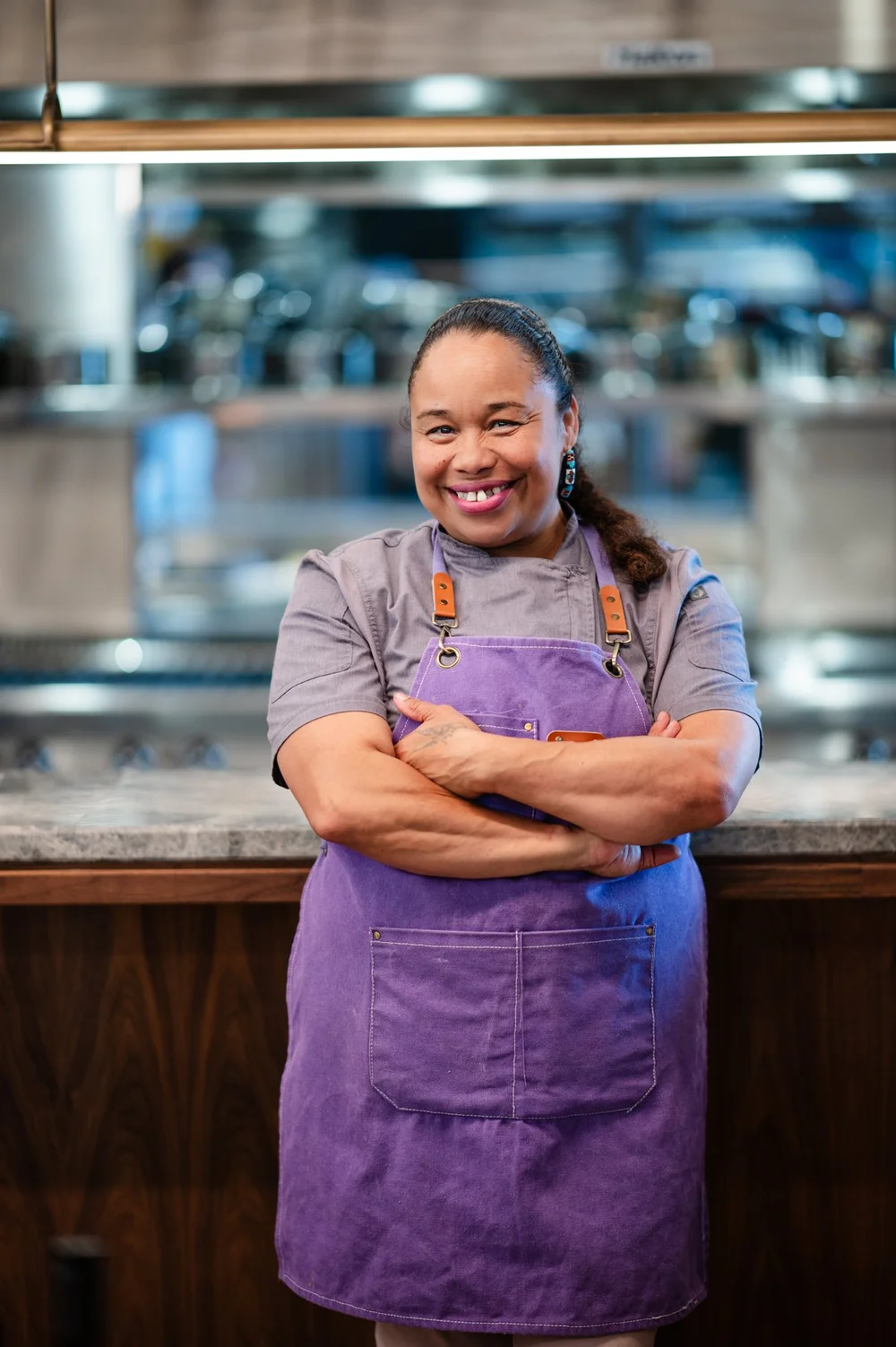
Chef Crystal Wahpepah, a registered member of the Kickapoo Tribe of Oklahoma, has long been a warrior for Indigenous food sovereignty. She is the creative tour de force behind the inventive, healthy, and delicious dishes served at her restaurant, Wahpepah’s Kitchen, in Oakland, California—the first Native woman-owned restaurant in Northern California.
Crystal understands the deep and powerful role that food holds in our lives and uses it as a bridge to connect others with Native issues that are important to her and Wahpepah’s Kitchen. By acknowledging the Indigenous inhabitants of the land upon which we currently live, she reasserts the legacy of Native foodways. Through this connection, Crystal is then able to educate others on the health benefits of Indigenous foods through the knowledge that has been passed to her.
Crystal has been inducted to the Native American Almanac for her work on behalf of indigenous food systems. She has appeared on Food Network’s Chopped and Beat Bobby Flay. She was named a finalist for the James Beard Award for Emerging Chef in 2022. Wahpepah’s Kitchen was the best new restaurant in the Bay Area in 2022. From 2025-2026, Crystal served as the chef-in-residence for the Rou Dalagurr Food Sovereignty Lab at Ca Cal Poly Humboldt. Crystal has cooked for the White House Hunger Conference with the James Beard Foundation and for the Academy of Motion Picture of Arts and Sciences. (from her website)
What I thought….
I grew up in Oklahoma in an area between two reservations (the Ponca and Otoe-Missouria Tribes). I was a minority at my high school. My friends were from these tribes. For many years, I mistakenly thought I knew a lot about Native cultures since I grew up with these kids, attended Pow-Wows with them and even worked through high school and college at a tribal bingo hall. In adulthood, I realized I had no clue. While I counted my Native classmates as friends, I had no idea about their true identity and history. I had no idea what foods they ate (beyond fry bread and Indian tacos).
I also hate to admit it but I had no recollection of ever hearing about the Indian Relocation Acts of 1952 and 1956, “encouraging” thousands of Native people to relocate to places like Oakland, CA. Wahpepah’s family was one of these to relocate. Tommy Orange, the esteemed novelist of There, There and other books, introduces this cookbook. Orange’s family relocated as well and Tommy was born in Oakland.
Where is this little nugget of history and why is it not taught? Oklahoma history was and is a required course for high school graduation here. I thought all the relocation acts happened (still tragically so), in the 1800s….
These were my thoughts as I dove into the book.
The blurb insinuates that the book is categorized by season. Sort of. But, it is more by ingredients: Three Sisters/Neowi Ototeemetiaki (Corn, Beans, Squash combos), Foraged Foods/Anesithaakeki Ithenieni, Game and Fish/Wiiyaathi Chakisii Memeethaki, Wild Rice and Ancient Grains/Manoomini Miikieni Okweeminaki) and Beverages and Teas/Ochiikaapowi.
This book prompted me to make a list of foods to source (and to perhaps plant next year):
- Tepary beans (known for their creaminess and slight sweetness)
- Cranberry beans
- Buffalo Creek squash (an heirloom white Hubbard squash)
- Dried hominy
- Blue cornmeal
- Amaranth (both whole grain and flour)
- Miner’s lettuce
- Wild green onions
- Duck Eggs
- Venison
- Bison
- Wild turkey
- Smoked cedar salt
Wahpepah lists farms and companies in the back of the book where these items can be found.
Some of the condiments were just incredible like Maple Oil (equal parts maple syrup and olive oil with a pinch of salt), and her version of Chili Oil (grapeseed and olive oil with onion, cinnamon, anise, chilis, garlic, peppercorns, pepper flakes, and maple syrup).
Throughout the book, she offers traditional tales, tips and secrets, and stories and histories.
One of the stories is found in the headnote to the Frybread/Keetahteehi recipe.Wahpepah does not offer frybread on her restaurant’s menu. If a catering client requests it, she will make it. It’s a complicated history.
I debated whether to include a recipe for frybread in this book because it is a food that fills many Native Americans with conflicting emotions. It was a survival food made necessary only because of the forced displacement of Native peoples and the commodities food program by the U.S. government…. In the end, though, I felt I would not pay proper respect to my grandmother or the memory of making soup with her without honoring our making frybread by hand together. That memory is comforting to me, as frybread was in times of scarcity. Its remaking as sustenance shows the ingenuity of our people. (99)
Wahpepah does make her recipes accessible by incorporating olive oil, coconut milk, a little dairy, a little flour, a little sugar. Mostly though, her sweetness comes from maple syrup.
There are some good “smoky” recipes in the book like Cedar Smoked Refried Beans/Pahteewi Ihskopahaakani Mahskochiitaki (67) and Smoked Squash Puree/Pahteewi Aapikooni (119).
The vinaigrettes are amazing, mostly berry-based but with some incredible sage variations.
Other wisdom I gleaned from this book.
- Maple syrup has some of the same antifungal properties of honey. And, also like honey, can help build up tolerances against seasonal allergies.
- Huckleberries have antiviral properties (and contain a high amount of fiber).
- Bee Balm is a super antimicrobial medicine (both the flowers and dried leaves).
- Sunflower petals are full of vitamin A.
- Winter squash can serve as a diuretic.
- Gooseberries have a high calcium content.
What to make? I have a list of all of the vinaigrettes. But I landed on her Berry Sorbet (with a hint of ground sumac) (160). The berries (I used a mix of blueberries and blackberries), along with maple syrup, ground sumac and a dash of salt yields a really rich dessert.
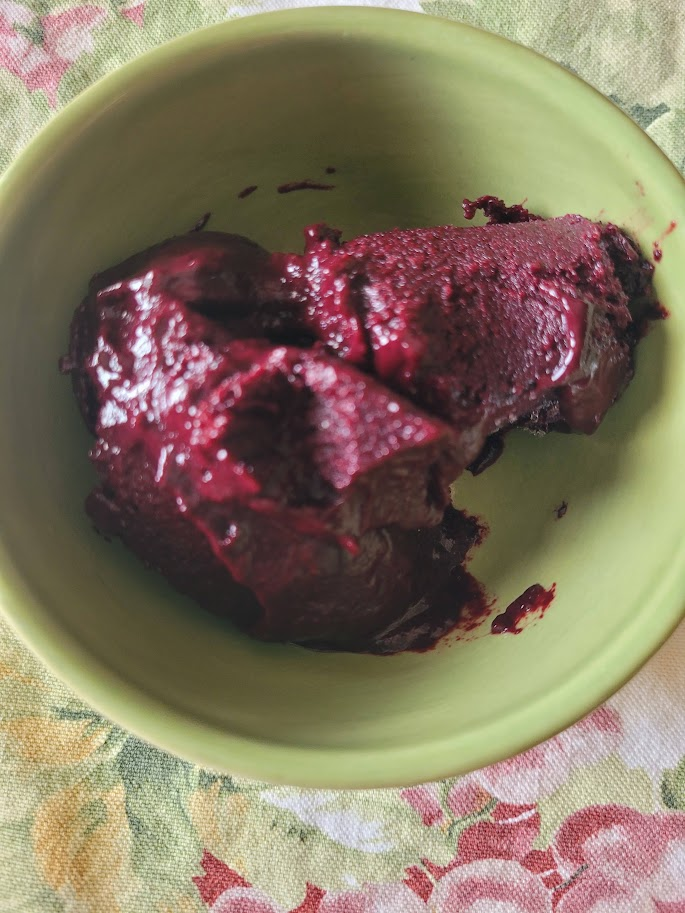
I was totally surprised as how rich this dish was. This is a no-churn frozen dessert—just blend it all up and put this in the freezer.
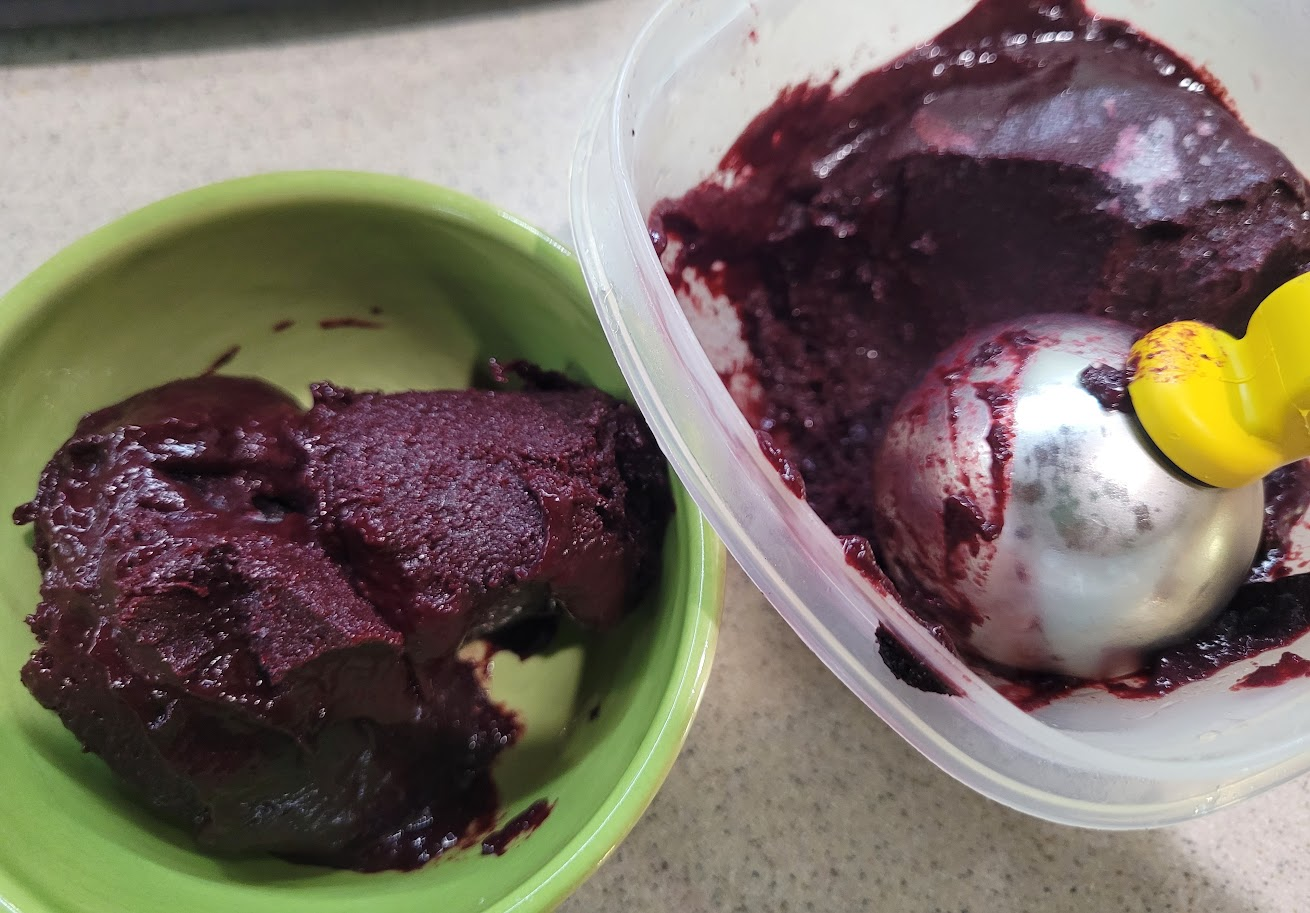
Don’t judge my photos They are very poor. But, the sorbet was delicious!
This book is full of traditional foods that are delicious. Wahpepah’s focus on the simple and basic yields a book full of elevated recipes: Sweet Potato and Smoked Hibiscus Taquitos with Tomatillo Salsa and Hibiscus Sauce, Sweet Potato Tostadas with Chili Oil and Pumpkin Seed Cream, Bison Ribs with Blueberry Barbecue Sauce, Salmon and Watercress Cornbread Sandwiches, Floating Duck Islands with Berries and Squash Cream, Mayan Chocolate Amaranth Cake, Blackberry Sage Tea. Any of these could find their way to a fine-dining restaurant. Oh, wait. They already have. At Wahpepah’s Kitchen in Oakland!
This may be one of the best cookbooks I have reviewed so far. Most all of the recipes are accessible and can easily be made even if you have to substitute a thing or two (like chicken eggs for duck eggs and pinto beans for tepary beans).
Seek this one out.
I am linking up with Foodies Read for August.


I am going to see if I can find this at my library. Thanks for the review.