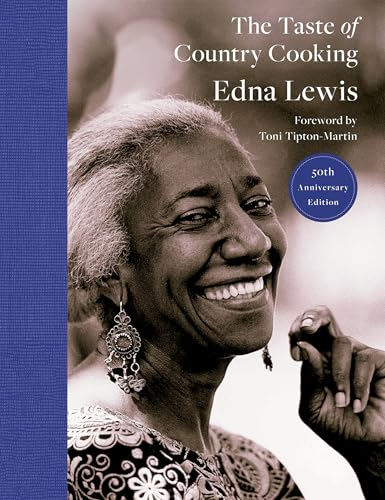
I became aware of Edna Lewis during a hosting stint for Cook the Books. I had recommended and was hosting A Place at the Table by Susan Rebecca White. (You can read my reviw here.) One of the characters in this novel was based on Edna Lewis. Honestly, before I read A Place at the Table, I did not know about Lewis and her seminal cookbook. So when I saw the 50th Anniversary Eddition of The Taste of Country Cooking at the library, I grabbed it! I also had just read about it in Southern Living. (I really wanted to recommend this book for the next round of Cook the Books, but after some checking, it wasn’t readily available in some libraries.)
About the book:
The most beloved Southern cookbook of all time: a glorious celebration of seasonal eating that has shaped generations of home cooks, from “the first lady of Southern cooking” (NPR). Beautifully repackaged and redesigned, with a new foreword by Toni Tipton-Martin.
“A classic, showing Americans the bounty of Southern cuisine and influencing generations.” —Melissa Clark, The New York Times
“Indispensable . . . An inspiration to all of us who are striving to protect both biodiversity and cultural diversity by cooking real food in season and honoring our heritage through the ritual of the table.” —Alice Waters, James Beard award-winning chef and founder/owner of Chez Panisse
With the publication of The Taste of Country Cooking in 1976, Edna Lewis proclaimed the food of the American South one of the world’s great cuisines. From the field greens and salads of spring; pan-fried chicken and crushed peaches in summer; preserves and sweet potatoes for fall; and hearty soups and stews during the cold winter months, Miss Lewis (as she was almost universally known) extolled the virtues of the good food of her childhood, spent in a Virginia farming community founded by her grandfather and his friends after Emancipation.
A celebration of eating locally—decades before “farm to table” became common parlance—the book showcases the joys of cooking with the seasons.
The 150 accessible recipes in its pages include:
- Baked Virginia Ham, Buttered Jerusalem Artichokes, and Rhubarb Pie in Spring
- Green Tomato Preserves, Wilted Lettuce with Hot Vinegar Dressing, and Fresh Blackberry Cobbler in Summer
- Crispy Biscuits, Green Bean Salad with Sliced Tomatoes, and Country-Fried Apples in Fall
- Oyster Stew, Pan-Braised Spareribs, and Coconut Layer Cake in Winter
An affirmation of a distinctly American way of eating, fifty years after its publication, The Taste of Country Cooking remains the definitive book on Southern food. (From Penguin-Random House)
About the author:
Ms. Lewis was born in 1916 in Freetown, Orange County, Virginia, one of eight children. Her grandfather, an emancipated slave, helped found the community, hence its name. The family lived on a farm that had been granted to her grandfather and central to the family’s life was food in all its phases: growing, foraging, harvesting, and cooking. Without any modern cooking conveniences—everything was cooked over wood and, lacking measuring spoons, baking powder was measured on coins—food preparation called on creativity, resourcefulness, and ingenuity.
At 16, after her father died, she left Freetown for Washington, D.C., and then New York City where her culinary journey got off to a rocky start with her first job ironing in a laundry. She had never ironed before and was fired after three hours. She may not have ironed but she had sewn, and quickly found work as a seamstress. She copied Christian Dior dresses for Dorcas Avedon (the wife of photographer Richard Avedon), made a dress for Marilyn Monroe and became well known for her African-inspired dresses.
In New York, after a series of jobs, she opened a restaurant, Café Nicholson, in Manhattan’s East Side. She became a local legend and cooked for many celebrities such as Marlon Brando, Marlene Dietrich, Tennessee Williams, Greta Garbo, Howard Hughes, Salvador Dali, Eleanor Roosevelt, and Truman Capote. In the late ’40s, female chefs were few and far between and black female chefs were a rarity, yet Edna Lewis became well known and beloved for her simple, but delicious Southern cooking.
Edna Lewis cookbooks: Ms. Lewis was the author of three seminal cookbooks that, to quote The New York Times, February 2006, “revived the nearly forgotten genre of refined Southern cooking (sic) while offering a glimpse into African-American farm life in the early 20th century.” Her cookbooks include The Edna Lewis Cookbook (1972), The Taste of Country Cooking (1976) and In Pursuit of Flavor (1988).
Among her many awards are: “Who’s Who in American Cooking,” (Cook’s Magazine, 1986); “Dr. Edna Lewis is lauded as one of the great women of American cooking. A specialist in Southern Cooking, She has received an honorary Ph.D. in Culinary Arts from Johnson & Wales University (Norfork), College of Culinary Arts May 26, 1996”; “James Beard Living Legend Award” (their first such award, 1999), and being named “Grande Dame” (Les Dames d”Escoffier, 1999).
Dr. Edna Lewis died in 2006 at the age of 89. (From The Edna Lewis Foundation website.)
What I thought…
Like I said above, I was pretty ignorant as to the depth of gratitude we should all pay to Dr. Lewis. Toni-Tipton-Martin’s “Forward” not only points out the influence of Dr. Lewis (and Southern cuisine) but also reinforces the fact that rural-Southern cooking has always been “farm-to-table.” Her recipes were just “naturally good food—with ingredients and methods that are deeply connected to the land and self-care” (xi).
The book is categorized into seasons and each season brings about a tale (or two) and menus for a seasonal breakfast, lunch and dinner. Some of the meals are more special and have a long list of items like “Wheat-Harvest Midday Dinner” and “Sunday Revival Dinner.” Spring brought shad and dandelion wine to the breakfast table. (The wine was used more like a tonic.) Not only did summer bring a deluge of fresh fruit, “There would also be unexpected meat dishes whenever the hay mower clipped the legs of rabbits and quail that were feeding or living in the hay-field” (49). To a citified person, this might sound cruel. To country folk it was just a practical reality and good luck.
Summer was also the time for cooking the first hams of the season (July and August). Ham was the go-to meal for unexpected guests: “Ham held the same rating as the basic black dress. If you had a ham in the meat house any situation could be faced” (49). Another summer recipe, elegant in its simplicity is “Sliced Tomatoes with Special Seasoning” (82). Sprinkle granulated sugar and black pepper “liberally” on top of sliced summer ripened tomatoes with the lightest touch of salt. Let them marinate for 10-15 minutes. That is all (except for a garnish of chervil). Most of the canning and preserve recipes can be found in the “Summer” section along with plum and blackberry wines.
Fall brought about melancholy: “When the leaves began to fall, all the vistors were gone, and the whistle from the train passing through Orange gave a long, lonesome, shrill sound as it rolled through without stopping to let off any passengers” (137). Fall did bring excitement and things to look forward too, though, like school starting, Race Day, and hunting season. It was also the time for harvesting late fruit like apples and dessert grapes and making wine and persimmon beer (150).
There is so much food history in the book along with great tips and practical recipes.
Lewis’ memories are lyrical and the essays that preface certain sections and recipes are priceless, informative, and historical. If you only read one essay, make sure it’s “Coffee or Java (as We Called It)” (23-24).
The smell of coffee cooking was a reason for growing up, because children were never allowed to have it and nothing haunted the nostrils all the way out to the barn as did the aroma of boiling coffee. (23)
My own family’s foodways and traditions started coming back to me as I read. (I grew up in the 70s-80s in rural Oklahoma.) These are the memories and recipes that Lewis shares that I could relate to:
- Picking wild asparagus in the bar ditch with my grandmother. We each had a paring knife to cut close to the earth (and check to see which shoots were woody).
- “Special Butter Cookies” (15) made me think of my Great Aunt Jaunita’s sugar cookies.
- Her dressing for the “Salad of Grand Rapids Lettuce Leaves and Romaine” reminded me of a dressing my grandmother would mix up, a quick vinegar and sugar one (32).
- “Yellow Vanilla Pound Cake” (60) reminded me of the recipe we used to enter cake contests growing up.
- We had our own version of “Wilted Lettuce with Hot Vinegar Dressing” (69) only we used our own fresh lettuce (mostly Black Simpson variety). Lewis’ recipe calls for iceberg.
- The “Wheat Threshing” essay talks about the stress put upon everyone: “Everyone was very tense the moment the men began cutting the wheat, as the hot weather carried the threat of thunderstorms and rain, which could descend at any moment and put a stop to the thresing” (97). Wheat harvesting is stressful indeed and still is today (or at least it was the last time I participated.)
Of course, this book is a cookbook full of simple but delicious recipes. It is more though. It is a memoir overflowing with wisdom of the past. There were many times as I was reading that I thought about the Little House on the Prairie books that I read in my childhood and the Foxfire books that I discovered during a college folklore class. Lewis’ voice, even through it is the 50th anniversary edition, comes through modern and fresh.
What I made…
I cannot tell you the last time I had wilted lettuce. I remember it as being an early spring and summer dish, basically when we could harvest lettuce before it bolted in our hot Oklahoma weather. Lewis’ recipe using iceberg lettuce really intrigued me. I adapted her recipe a bit, using spicy vinegar and adding hard boiled eggs (which is something we always did with our recipe). This is a simple but delicious salad that I used for a meal.
Wilted Lettuce with Hot Vinegar Dressing
Based on recipe by Edna Lewis
Ingredients
- 1 small head iceberg lettuce
- 3 slices bacon
- 1 t. Sugar
- 1/4 c. vinegar
- 2 hard boiled eggs, peeled and sliced
- salt and pepper
Instructions
- Remove the outer leaves of the lettuce and remove the core. Quarter the head and washwell. Drain. Chop the lettuce a bit more if desired. Place the lettuce in a heatproof serving bowl.
- Fry the bacon. Remove from pan and drain on paper towels. Leave about 2 tablespoons of fat in the skillet. Add the sugar and the vinegar. Bring to a boil, stirring well.
- Pour this boiling mixture over the lettuce in the heatproof bowl and stir until lettuce is wilted. Arrange the eggs and crumble the bacon on top. Serve while hot.
Yield: 4
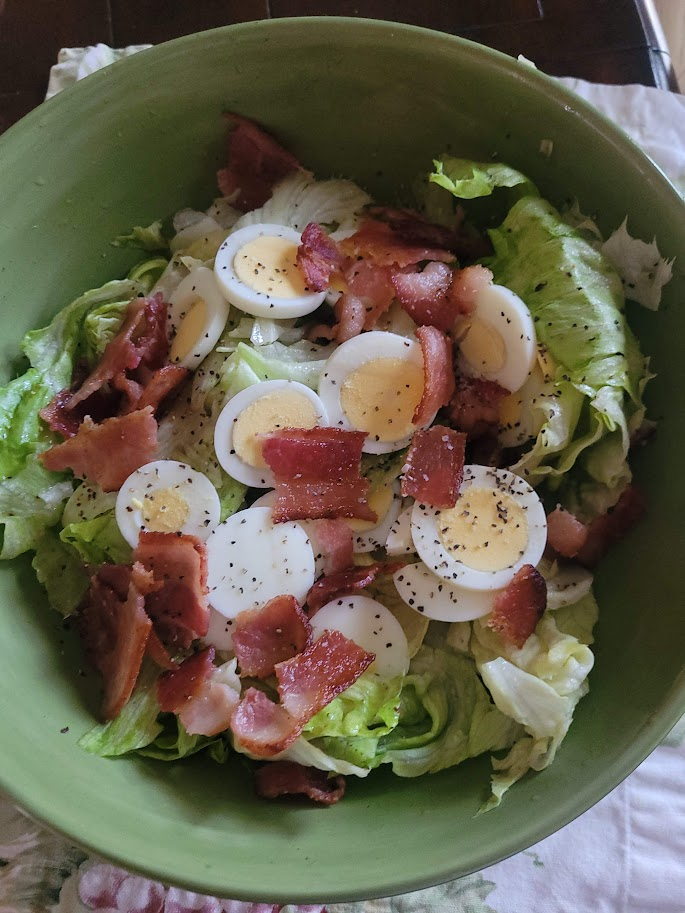
I feel like I remember there being onions along with the boiled eggs in our traditional family recipe, too. Pretty sure the dressing was the same. I am a bit unsure about the iceberg lettuce. It was actually better as leftovers the second day. I would make it again but will probably use a bib lettuce or red leaf lettuce next time (a more tender variety than iceberg).
Seek this book out for the essays and the writing. Then, make one of the simple and delicious and homey recipes.
I’m linking up with Foodies Read for September.


Leave a Reply