Miss Eliza’s English Kitchen by Annabel Abbs is the current selection for Cook the Books. Amy’s Cooking Adventures is serving as the guest host for this round. Thanks for joining us, Amy!
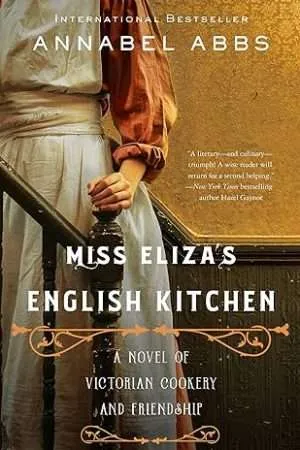
About the book:
INTERNATIONAL BESTSELLER
Good Housekeeping Book Club Pick * A Country Living Best Book of Fall * A Washington Post Best Feel-Good Book of the Year * One of the New York Times’s Best Historical Fiction Novels of Fall
In a novel perfect for fans of Hazel Gaynor’s A Memory of Violets and upstairs-downstairs stories, Annabel Abbs, the award-winning author of The Joyce Girl, returns with the brilliant real-life story of Eliza Acton and her assistant as they revolutionized British cooking and cookbooks around the world.
Before Mrs. Beeton and well before Julia Child, there was Eliza Acton, who changed the course of cookery writing forever.
England, 1835. London is awash with thrilling new ingredients, from rare spices to exotic fruits. But no one knows how to use them. When Eliza Acton is told by her publisher to write a cookery book instead of the poetry she loves, she refuses—until her bankrupt father is forced to flee the country. As a woman, Eliza has few options. Although she’s never set foot in a kitchen, she begins collecting recipes and teaching herself to cook. Much to her surprise she discovers a talent – and a passion – for the culinary arts.
Eliza hires young, destitute Ann Kirby to assist her. As they cook together, Ann learns about poetry, love and ambition. The two develop a radical friendship, breaking the boundaries of class while creating new ways of writing recipes. But when Ann discovers a secret in Eliza’s past, and finds a voice of her own, their friendship starts to fray.
Based on the true story of the first modern cookery writer, Miss Eliza’s English Kitchen is a spellbinding novel about female friendship, the struggle for independence, and the transcendent pleasures and solace of food. (From Harper Collins.)

About the author:
Annabel Abbs is a multi-award-winning writer of fiction and nonfiction, published internationally in 30 languages. She has a degree in English Literature from the University of East Anglia and a Masters from the University of Kingston. She lives with her family in London and Sussex, and is a Fellow of the Brown Foundation.
Miss Eliza’s English Kitch is Abbs’ third novel. Abbs also writes non-fiction books including Windswept: Why Women Walk, was published in June 2021. Windswept tells the extraordinary stories of eight women who walked long distances in wild and often remote places as they sought their own voices: Simone de Beauvoir, Nan Shepherd, Georgia O’Keeffe, Gwen John and Daphne du Maurier.
All in, both non-fiction and fiction, she has penned eight books.
Abb has written for numerous publications including The Guardian, The Observer, The Washington Post, The Paris Review, Tatler, The Irish Times, Aeon, Good Housekeeping, Weekend Australian Review, Elle, Sydney Morning Post, The Author, The Daily Telegraph, Psychologies Magazine, Philosophy Now and the Huffington Post. She has been profiled in The Guardian, Writing Magazine, Sussex Life, Next NZ, Litro and Female First and speaks regularly at literary festivals. She sponsors a scholarship/bursary on the UEA Creative Writing MA. (Edited from her website.)
What I thought…
I read this book back in September…. No idea why I read it so early…. I must have been in between books. Regardless, I had to go back and review the few notes I took. A couple of things surprised me about this book. I had no idea that Eliza was a real person, a domestic goddess of the Victorian age. I kind of wish I would have realized this before I read the book; I think I would have enjoyed the tale more.
The book is loosely based on Eliza Acton, who helped shape how cookbooks and recipes are written. In the novel, Eliza starts out as a poet who’s pushed into writing a cookbook (much to her dismay), but she has to survive. Ann is truly her savior here. I’m not sure without Ann’s palate and insight that Eliza would have been as successful.
Eliza and Ann have a complicated relationship and the emphasis on class distinctions is evident. While Eliza may be Ann’s savior, too, the boss can be a bit picky and opinionated.
The Food:
The food is obviously plentiful in this novel and I had a few highlights on my Kindle that I kept coming back to. One was Eliza’s experimenting with lavender in a lemonade. Ann states that drinking this beverage is “like coming from a gray dream and feeling the world lift and rise around me. Calming.”
I was also taken with this passage, which shows Eliza’s thought process:
tip the rose hips into a large bowl, tasting them on my mind’s tongue . . . folding in thyme . . . or rosemary . . . or would a hint of something more exotic work? A stick of cinnamon? The quick dip of a vanilla pod? I try to recall the rose hip syrup Mrs. Durham used to make and a rich French rose hip preserve—with apples? elderberries?
The above quote had me researching rose hip preserves and jams.
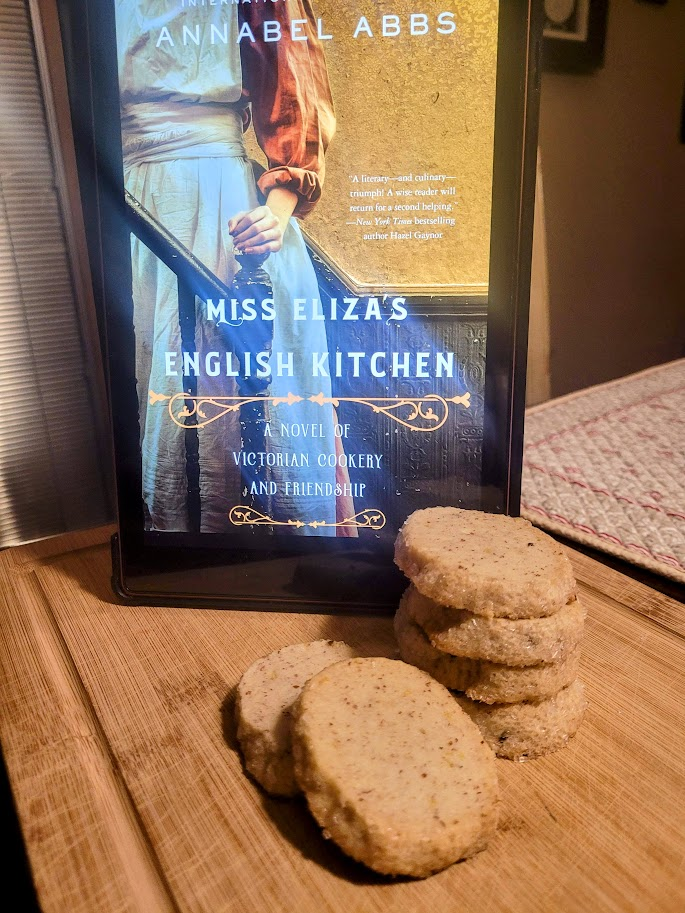
Instead, I went to a cookie dough from Linger by Hetty Lui McKinnon that I have whipped up twice. The original recipe uses orange zest and ground ginger. I used lemon zest and lavender instead.
Know that this cookie does have to chill for 2-3 hours (and can be chilled overnight).
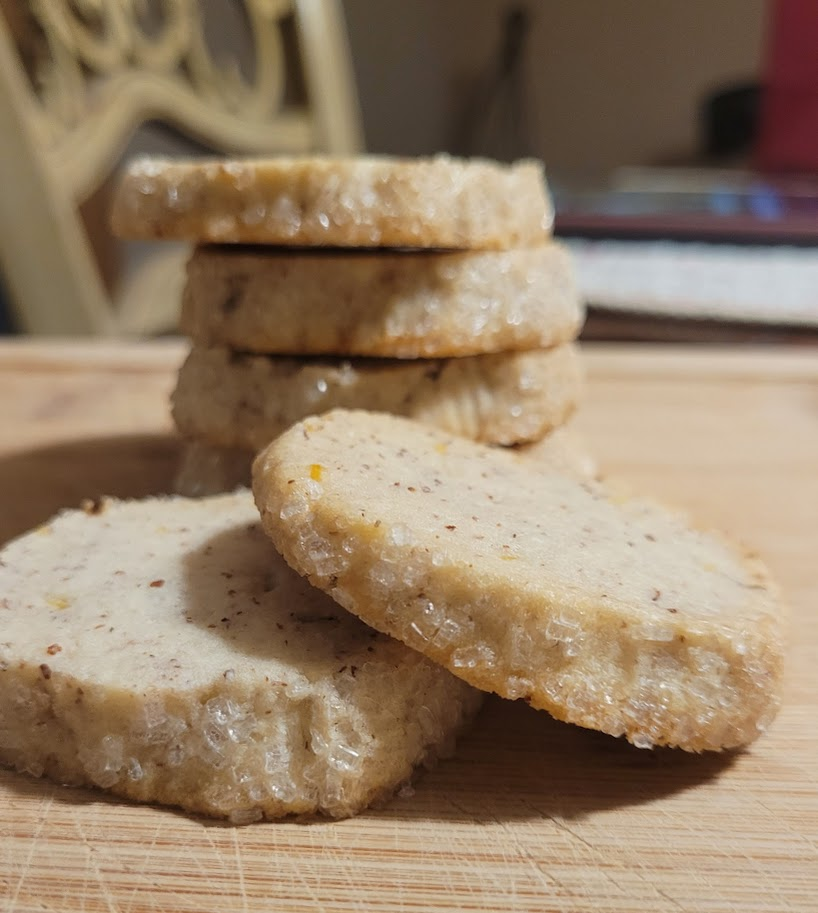
Lemon-Lavender Butter Cookies
Based on Sparkly Orange Ginger Butter Cookies by Hetty Lui McKinnon from Linger
I replaced the orange zest with lemon and added some lavender blossoms.
Ingredients
- 1 c. (2 sticks) butter, softened at room temperature
- ½ c. granulated sugar
- 1 large egg
- 2 t. pure vanilla extract
- Zest of one large lemon
- 2 c. all-purpose flour
- ½ c. almond flour
- 1/2 t. salt
- 2 t. dried lavender flowers (for culinary use)
- ⅓ c. sanding sugar or turbinado sugar
Instructions
- In a stand mixer fitted with the paddle attachment cream the butter and the sugar until smooth (about two minutes). Add the egg, vanilla and lemon zest. Beat on high until combined (about one minute). Scrape sides of bowl.
- Reduce speed and carefully add the flour, almond flour, lavender flowers and salt. Beat until well combined (about one minute).
- Divide the dough into two portions, roll each portion into a log shape, wrap in plastic wrap and refrigerate for at least two hours (or up to 12 hours).
- When ready to back, preheat oven to 350 F. Line cookie sheets with a silicon pad or parchment paper.
- Place the saddening sugar on a rimmed baking pan or any flat surface. Remove the logs from the refrigerator and roll the logs in the sanding sugar. Slice into ¼ inch slices. Place on cookie sheet at least ½ inch apart.
- Bake until the edges are just golden (12-14 minutes). Remove to cooling racks. Cool completely.
Notes:
- Wrapped cookie dough can be stored in the refrigerator for up to 1 week. Slice and bake as you like.
- Baked cookies can be stored in a sealable container at room temperature for up to a week.
- Baked cookies can be frozen for up to three months.
Yield: about two dozen cookies
The next four book selections are Call of the Camino by Suzanne Redfearn, Kitchens of the Great Midwest by J. Ryan Stradal, Mrs. Quinn’s Rise to Fame by Olivia Ford, and The Kamogawa Food Detectives by Hisashi Kashiwai, translated by Jesse Kirkwood. You can read the announcement post here.

Membership in Cook the Books is open to anyone and we hope you will join us by reading these selections and creating inspired recipes. For more information about participating, click here.
I’m also linking up with Foodies Read.


I read this book very early, too, as I have with Call of the Camino. I enjoyed both of them very much. I’m sure I would enjoy these lovely cookies as well. They are perfect for spring and Easter!!
Those cookies sound delightful. I believe they too would be “like coming from a gray dream and feeling the world lift and rise around me. Calming.” I really need to get some lavender growing!
I also enjoyed the parts where we “overhear” Eliza’s and Ann’s thought process as they choose pairings for their recipes. I like your idea of pairing lemon zest and lavender flowers: I can imagine the sweet smell in the kitchen while baking the cookies 🙂