I bought Bite by Bite a couple of summers ago when I went to Nashville for a conference. My two nerdy co-workers and I got off the plane, checked into the hotel, and then ubered to Parnassus, the bookstore owned by Ann Patchett. We did not immediately seek out Broadway St. or Printers’ Alley. We didn’t go straight to the Grand Ole’ Opry or the Ryman. We’re totally word nerds. We went to a bookstore.
I had intentionally left room in my luggage to take home books. We did not get to see Ann Patchett in the store. I did, however, buy every book I didn’t have of hers (all autographed) and I came out with a few other signed copies like Tommy Orange’s latest and Bite by Bite by Aimee Nezhukumatathil.
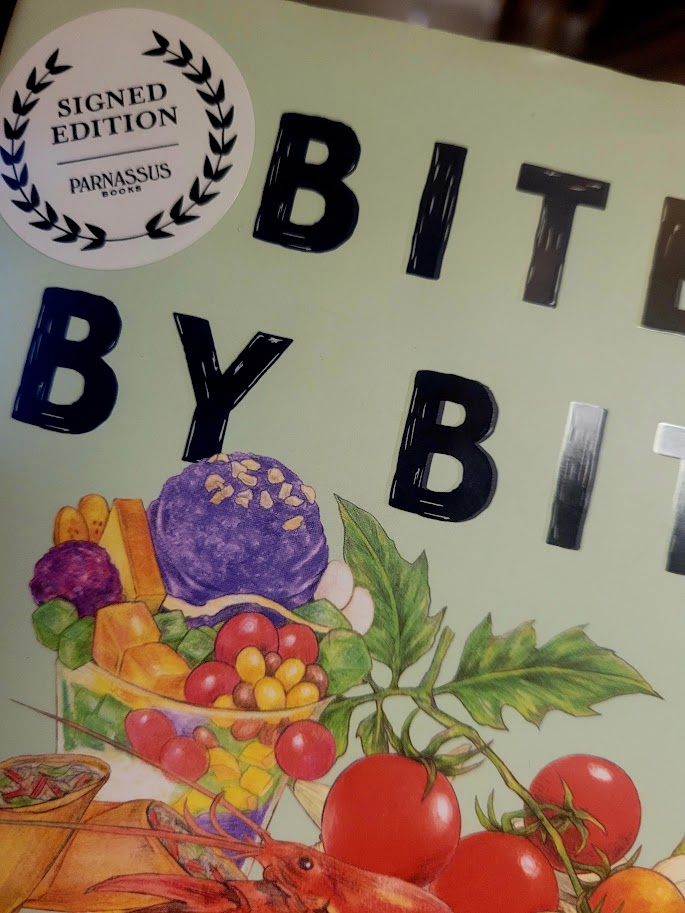
The art on the cover intrigued me and the first few pages I read while still in the store were just lyrical.
Upon my return home that summer, I stuck it in my TBR stack. There it sat until January 2026. Luckily, Nezhukumatathil’s book is a quick (but very entertaining) read. It’s one, because of the essay structure, that can be picked up and put down and jumped back into easily. Basically, it was the perfect selection for the December/January round for Cook the Books. Simona of bricriole is hosting.
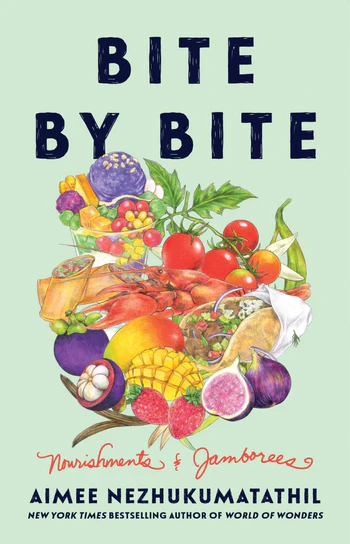
Aimee Nezhukumatathil is known for her poetry and that talent certainly comes through in her prose. She is also a teacher (a professor at Ole Miss). Her lessons move outside of the classroom though. She extolls her parents to just sit still and enjoy. She taught her sons (as infants) to relish that first bite of banana. She teachers her international students to enjoy a fire pit and experience S’mores for the first time. Her love of teaching and sharing is evident in each essay.
This book is a bit of personal and natural history, a serving if you will—scooped up with a dollop of the bounty and largess of the edible world. It’s also an exploration of the banquet of saporific wonder that the planet offers us, the wonder I hope you carry back to share with others. (x)
Regarding her voice and style, the author can be in a self-deprecating recollection, like of her first slumber party hosting experience. Her honesty and transparency includes humor: “I just wanted it to be like everyone else’s birthdays. I should have known the very fact that a fourteen-year-old was having a birthday sleepover at a mental asylum meant I’d never ever be like everyone else, so it would be pointless to pretend” (23). And, then she writes one line, one line that brings the poetry back into her recollection: “This is a food essay that remembers jamboree” (23).
Bite by Bite is also a gardening book. Tomatoes make her think of her mother and a grandmother she barely know. She references her mother’s garden often. Her sons keep fruit time: “May means strawberries, June is peaches, August equals watermelons, and September is persimmons” (86).
Ultimately, it’s a book about memory, family, love, and joy. It’s a jamboree!
Nezhukumatathil structures Bite by Bite into different essays, each revolving around food and a food memory. Along with her remembrances, she weaves food history into her lyrical prose. Each essay includes a simple but lovely illustration.
In “Rambutan,” she describes coming to terms with her unruly hair. She equates her locks to wild horses and quotes Virginia Woolf: “Blame it or praise it, there is no denying the wild horse in us.”
“Mango” includes a self portrait and the melding of two different cultures (Indian and Filipino). She relates explaining seemingly simple aspects of her culture to her white classmates. I mean, who doesn’t know what a mango is. (Well, maybe in the early 90s….)
Each of the essays held its own wisdom and imparted knowledge, but my favorite essay was “Strawberry.” I liked how she started with a cultural reference from the 70s and 80s, the doll and cartoon character Strawberry Shortcake, and then went on with snippets of her personal thoughts.
Forgive me, but I could think of no other way to organize my thoughts for this post and I started out focusing on each of her essays one by one. IF you want to read my thoughts and the quotes and stories that spoke the most to me, please skip to botom of this post. (I did not continue to highlight each essay. After the “Blackberry” one I realized my error and just read to enjoy.)
What to make. I was immediately drawn to lumpia, then to a lychee martini, then to her mother’s elusive chicken curry (and the potato bits). Beyond these, though, inspiration could be found on almost every page….all the fruit, all the sweetness.
I kept coming back to the lumpia essay: “This is not an essay that is ashamed” (22). Lumpia was a staple of her childhood and any family party or celebration. She is initially embarrassed that her mother is making lumpia for her slumber party when she just wanted pizza and 2-liters of Pepsi. But, her mother chides her, “A party without lumpia? No, we don’t do that” (23).
Of course, the little fried rolls were a hit at the party. Just like coming to terms with her hair in the first essay, she comes to terms with her food heritage in this one.
Her mother added raisins to her filling for just a hint of sweetness so I found a recipe for Filipino Lumpia and my plan was to add some to this recipe. Unfortunately, during our snowmageddon, I didn’t run to the store so I couldn’t buy the ingredients for lumpia.
I did have everything for a chicken curry though. I used this recipe. Her favorite part of her “mother’s curry was the potatoes sopped in ginger, coriander, cumin” (143). While my recipe had all of those ingredients, I am pretty sure it would not hold a candle to her mother’s. In fact, it was pretty darn meh.
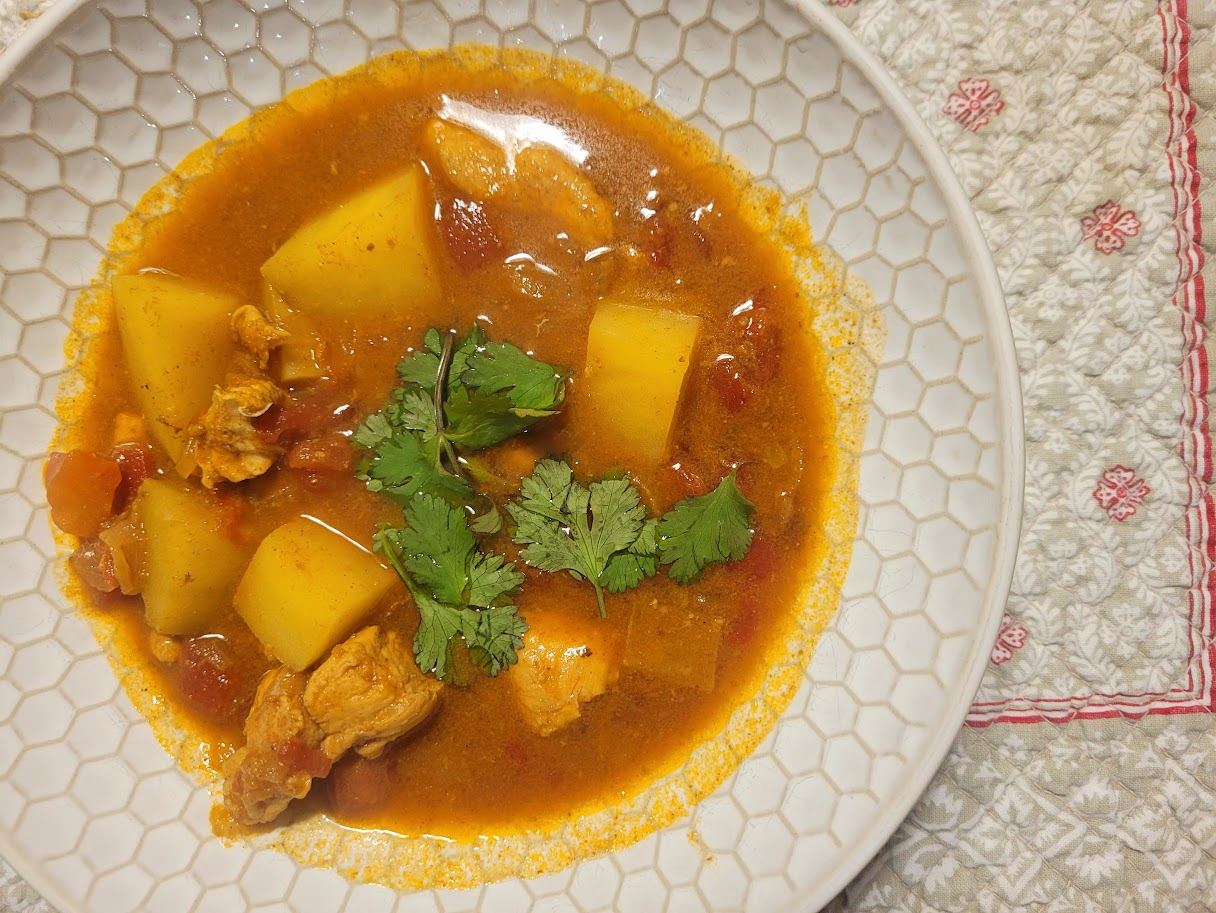
I should have spent some more time researching this but I was down to the wire on this deadline. I am anxious to see how it is tomorrow as leftovers though.
I know this is an overly long post (even with my attempts at editing) but I would be remiss if I did not address the writing prompts at the back of the book. I once attended a food writing workshop at a local university and fell in love with the authors that presented. I loved that experience. Bite by Bite invoked a similar response in me, not just the prompts, but every single essay. I can only imagine being in Nezhukumatathil’s classroom and learning from her. I would love to attend one of her author events/poetry readings. I’m going to check out the local bookstore soon for her poetry works. Thanks to Simona for picking the selection for this round!
Please consider joining up with Cook the Books in February/March. Guest host Amy (Amy’s Cooking Adventures) chose the novel Miss Eliza’s English Kitchen by Annabel Abbs (also known by its title in the UK as The Language of Food). Check out an announcement post soon at Cook the Books.
I’m also linking up with Foodies Read.
Here’s my musings on a few of the opening essays. It’s basically just notes from my reaidng.
Paw-Paw: I don’t think I’ve ever tried a paw paw and I had no idea they were called Ozark Bananas (along with many other nicknames). Paw-paws remind her of Friday Night Lights and fall.
Lumpia: “This is not an essay that is ashamed” (22). Lumpia is a fried finger food filled with ground chicken, beef or pork and often served with a sweet chili sauce. “Lumpia has always been synonymous with gatherings, with parties” (23). In fact, her mother chides her, “A party without lumpia? No, we don’t do that” (23). Her mother added raisins to her filling for just a hint of sweetness. Just like coming to terms with hair in the first essay, she comes to terms with her food heritage in this one.
Tomatoes: I think if you have ever experienced the taste of a perfectly homegrown, vine-ripe tomato, you could agree that it is the best thing you have ever eaten. Nezhukumatathil goes beyond that in her essay and again focuses on family—memories captured on a Super 8 of her two-year-old self leading to memories of a grandmother she barely knew. “I write this song of tomatoes to my Lola” (29).
Bangus: The national fish of the Philippines is the highlight of a hearty and good breakfast. The fish is marinated in garlic and ginger, fried, and served with garlic fried rice and a fried egg. The author holds these breakfast memories close: ” For years, this kind of breakfast meant my mother and I were waking up in the same house” (31). These Bangus-centered breakfasts mean home, whether it’s shared with her mother or with others friends that appreciate the Filipino breakfast and fellowship.
Rice: I do know that Nezhukumatathil is a bit younger than me, but I can so appreciate her childhood memories—wanting the hippest school supplies (like the jumbo pen with lots of colorful clicks) or coveting the teacher’s pot of rubber cement. These are odd anecdotes to start an essay about rice, but consider her mom’s oft used phrase “use rice.” Here mother didn’t have fancy pots of rubber cement or even the frowned upon glue paste. They used rice. (Just like the builders of The Great Wall, she points out.) This put her in her place. The author also fondly remembers her mother’s rice song and the foolproof way of cooking rice (water to rice ratio measured by your ring finger).
Pineapple: Nezhukumatathil used the old wives’ tale of eating pineapple to induce labor with her eldest son. It worked. Later as a Kindergartner, he tells her before he goes to sleep that he needs to take three pineapples to school the next day for “sharing.” (It’s the middle of a snow storm.) Pineapple represents lots of family memories in this short two page essay including the “pineapple jamboree” on her windowsill.
Onion: She employs an abecedarian to honor the onion. These tidbits include facts, tips, history. What I learned? I had never heard of the King of the Onions or the Onion Futures Act of 1958. Also, if you dream of onions, you might need to be ready for spite and envy and rivalry.
Lychee: “What’s inside a lychee bounces us glimmer-glimmer and lusters lamplight into moonlight on our walls and floor” (49). She departs from focusing on family memories to remembering her “found” family in NYC during her early days as a new English professor. She would trek to the city to find fellowship and laughter with other young Asian writers. And, perhaps, “A few lychee martinis here and there” (51).
Mint: A bit of history is presented again and I learned about Minthe, a nymph that Persephone stomped to the ground in jealousy. Nezhukumatathil recalls Wrigley’s spearmint gum and her mother’s purse and equates herself to the mint runners connecting her to her mother.
She’s the one who taught me how to garden, how to get my hands in the soil after the first frost, and when to prune and pull up errant growth. No wonder I’m a runner now, stretching for her light, for her small, for her reviving embrace. (54).
Jackfruit: I’ve seen jackfruit only a few times in our regular grocery store and I always have wondered about the quality. I mean, should I really spend $30+ dollars on a huge crazy looking fruit that somehow singly found its way to an Oklahoma grocery store? I’ve never been that brave. Jackfruit is her favorite fruit, ever since her grandfather presented it to her when she was eight.
I will never forget my grandfather, or my first taste of jackfruit from the man who took the time to type aerogrammes to me when I was in elementary school and sent those thin blue envelopes flying over to my side of the planet ever since I could read. (58-59)
Cinnamon: The spice of the holidays and one that represents prosperity, too. I wanted to quote the entire final paragraph of the cinnamon essay here. Instead, I urge you to read it on page 62 while you sip some spiced cider.
Apple Banana: She describes this smallish banana (her favorite) as “a party in our mouth featuring a banana host and a sort of pineapple-strawberry DJ spinning tunes. Apple bananas seem also to taste like flowers—plumeria, maybe…”(65). The scent of these fruits remind her to slow down.
Mangosteen: Another fruit I’ve never tasted and since I doubt I ever do, I will once again rely on her distinct description: “think a Creamsicle with a tartness of strawberries newly ripened under late May sunshine” (68). But, you will have to read her poem on pages 69-70 to fully experience the taste in words.
Sugarcane: There’s such a lovely Christmas Eve memory here. As I read her story of the joys of crunching and chomping on sugarcane, I vaguely remember our favorite aunt (and world traveler) giving us some sugar cane to “cronch” on. I need to ask my sister if this memory is true.
Figs: One of the loveliest illustrations opens this essay and I wish I could reproduce it here. Her words about fig wasps and crunching are a little less lovely. “I don’t worry the crunch; I celebrate the flight” (78).
Shave Ice: This has to be a food of jamboree. I was a little startled when I turned the page and saw the rainbow illustration. I was also confused by the typo. Not a typo. It is “shave” ice, not “shaved” ice. I believe Nezhukumatathil includes it here for the social commentary and the joy it brings. “Even as I write this, I can feel myself smiling” (84).

Had I been in Nashville with you, Debra, I’d also have gone straight to the bookstore. So nice that you got a signed copy! I also enjoyed a lot the essay on lumpia. I hope you get to make the recipe once the weather allows proper shopping. I think the author is not alone in having a beloved recipe that, no matter how lovingly made, does not produce exactly the dish we remember. Thank you so much for your contribution to this edition of Cook the Books 🙂
Had I been in Nashville, I would also have gone straight to the bookstore. How nice that you got a signed copy of the book! I’m also intrigued by mangosteen (it was featured in another book we read for the Club) and would like to taste it. I hope you get to make lumpia once the weather allows you to do the necessary shopping. I think we all have a recipe that no matter how lovingly we follow, the result does not match our memories. Thank you so much for your contribution to Cook the Books 🙂
We book lovers need to stick together! 🙂 Thank you for hosting!
I have been to Nashville but didn’t realize Patchett owned a bookstore and/or that it was in Nashville. Next trip LOL…
The first time I went, I had not idea. Then, she was on a book tour in Tulsa and I got to hear her/meet her. That’s when I found out about Parnassus. LOTS of signed copies there because I assumed she gets a lot of authors through her doors.
I had thought of making that chicken curry as well, but no authentic recipe. She never figured it out. But we can improvise! As soon as I get off this vegetarian diet for the colitis attack!
Oh no! Get better soon!