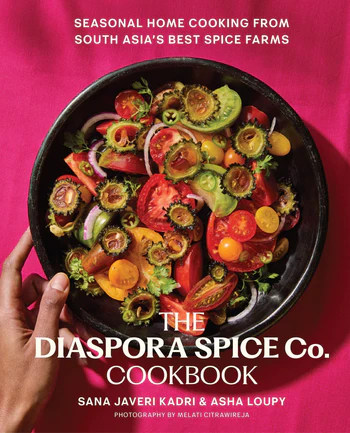
Still on the hunt for the best cookbook of Spring 2026? Here’s the latest review (gleaned from lists found at Bon Appétit and Forbes). Diaspora Spice Co. Cookbook is a beautiful and informative book. (And, I was glad to make the acquaintance with the company itself.)
About the book:
Eater’s Best Spring 2026 Cookbooks
Los Angeles Times Best New Cookbooks for Spring 2026
From Diaspora Spice Co., the progressive spice company rooted in flavor and equity, comes a cookbook celebrating beautiful, simple, and seasonal cooking with 85 recipes adapted from India and Sri Lanka’s best family spice farms.
Diaspora Spice Co. sources the most flavorful, fresh spices in the world from 150 regenerative farms across South Asia—from elders, indigenous communities, young changemakers, and brilliant multi-generational farming families across India and Sri Lanka who are leading the way in sustainable and climate change–resistant agriculture. Filled with culinary storytelling, The Diaspora Spice Co. Cookbook highlights these farmers and their spices with profiles and evocative photography, plus 85 recipes for simple, seasonal, and powerfully delicious meals.
CEO and founder Sana Javeri Kadri and recipe writer Asha Loupy realized that eating with the people who grow our spices unveils a whole new dimension in our cooking. For instance, the Mir family, who works all year to grow and harvest their saffron, shared not only their technique for blooming the vibrant spice and how to make sure every thread is fully utilized, but their unforgettably delicious dishes. Adapted for a global pantry, these recipes share the warmth of true South Asian home cooking at its truest and tastiest, starting with chutneys & pickles, snacks, and veggies, traveling through to mains from the sea and from the land, rice and breads, and ending with drinks and desserts.
Sana and Asha also note which recipes are the most beginner friendly, freezer friendly, good for a dinner party menu (like a Diwali feast!), and which lend themselves to be pantry building blocks, all for a super easy-to-navigate cookbook.
- Burst Tomato Chutney
- Perfect Pakora
- Spiced Maple-Roasted Carrots with Carrot-Top Sambol
- Aloo Masala
- Jammy Egg Curry
- Coconut Lamb Biryani
- Fennel Tom Collins
- Turmeric-Banana Snacking Cake
- Apricot-Saffron Frangipane Galette
This incredibly fresh, beautifully photographed, powerful collection is a celebration of these farming families, their precious harvests, and how they season recipes with big flavor. (From Harper Collins)
About the authors:
Sana Javeria Kadri is the founder and CE of Diaspora Spice Co., a farm-to-table spice company that prioritizes the highest quality, equity for workers, and transparency. Sana founded the company in 2017 with just Pragati Turmeric from one farm; the company now sources 30 spices from more than 140 farms across India and Sri Lanka. A third-generation native of Mumbai, she now lives in Menlo Park, CA.
Asha Loupy is a recipe developer and writer with more than a decade of experience in the specialty food industry, from cheesemonger to grocery buyer and e-commerce manager. She’s written for Bon Appetit, Food 52, Epicurious, and more. She’s based in Oakland, CA. (From Diaspora Spice Co. website)
What I thought….
This is just a beautiful book, from the cover to the photographs to the illustrations to to recipes. Sana, the founder, writes in the introduction that “On the surface, we just sell spices, and this book is just some recipes but if you look closely, it’s always been so much more than that” (x). She acknowledges that while her company is an Indian incorporated business, in some areas (like Kashmir and Manipur) they are the occupiers which causes her to continually ask things like “Does our work perpetuate erasure of culture and cuisine, or does it hold the promise of undoing some of the harm?” (x). She is also cognizant that since they are sharing heirloom recipes in this book, that they must “act as equitable translators.”
The book starts out with some great illustrations and timelines regarding Diaspora’s inception and growth and a map of India that personalizes their source farms.
Since this is an Indian spice company publication, I was expecting a long list of exotic spices for the pantry. In order for the recipes (and pantry) to be accessible, the authors kept it as basic as possible, but it’s still a long list. The only things that were in their list that I didn’t have in my own spice cupboard were Tejpatta leaves (“Indian bay leaves”) and asafetida (dried and ground gum resin). The same was true for the “Fats” section; the only oil I didn’t have was mustard seed oil. Now, though, the “Chillies and Peppers” section was a lot more exotic: Byadgi, Guntur Sannam, Sirarakhong Hathei, and Sivathei. Ingredients like salts, “Sour Things,” “All Things Coconut,” Sweeteners,” “Herbs and Aromatics,” “Dal” and “Rice” are also outlined in the pantry section. Throughout there are tips and more beautiful drawings. While the authors keep the spices to a basic minimum, you will need a lot of the chilli powders from those exotic peppers to make a lot of these dishes. Luckily, they do offer a few hacks like substituting hot Hungarian paprika for Byadgi chilli powder and Spanish smoked paprika or chipotle powder for Sirarakhong Hathei powder.
I love to mix up and give spice blends for gifts and there are five new spice blends that might make the gift baskets this year (22-28).
Each recipe is attributed to a person and their geographic origin along with photos. Profiles and photographs of the family spice and pepper farmers along with a list of their recipes are sprinkled throughout the book.
I mentioned earlier, that the authors kept the exotic spices to a basic minimum. While true, you will need a lot of the chilli powders from those peppers to make a lot of these dishes.
I will say that this cookbook had me checking out their website and I did order some spices for myself and for a birthday gift. (I did an order for the sample spice pack, Chaat Masala, and some really cool spice spoons.) While I know the authors were trying their best to make the recipes accessible, I still didn’t have all the chili spices (and other ingredients) for many of them. Even the “Most Beginner Friendly” recipes left me uninspired because I would still have to source ingredients.
The stories of the farm families are wonderful and I loved reading about them. The most intriguing recipes for me were the drinks: lots of chai recipes, fennel shrub, Fennel Tom Collins (with the fennel shrub), and Apricot-Tamarind Shrub. Sorry and no reflection on Diaspora Spice’s cookbook, but I just can’t get into cooking a lot lately.
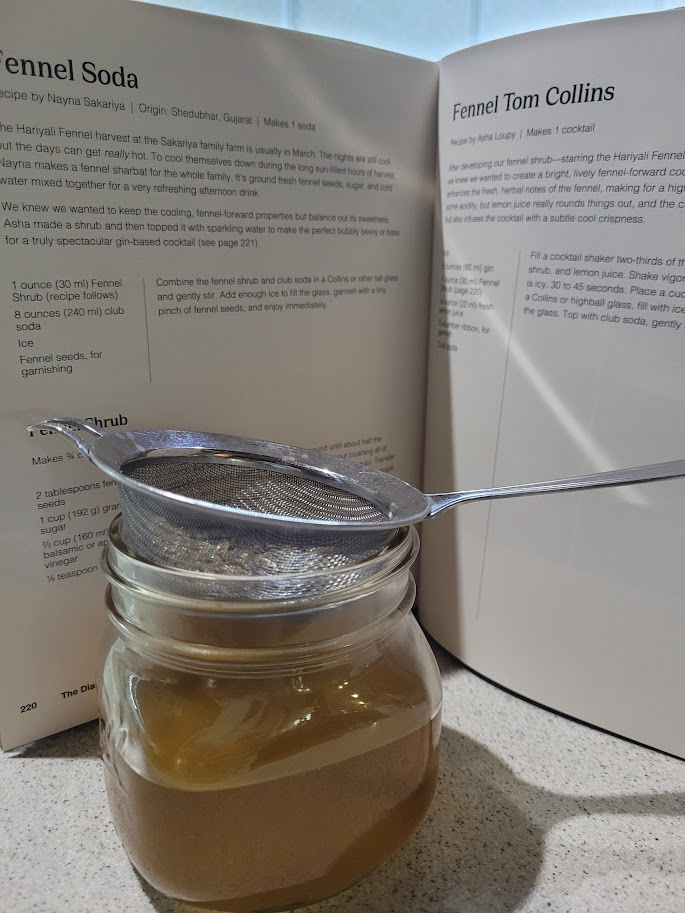
So, it was the fennel shrub. Very weird and I was very skeptical. IT’S AMAZING! The Fennel Tom Collins is so refreshing. I’m listing my version here (using a bit more lemon juice and tonic water instead of club soda).
First, make the fennel shrub. Crush 2 tablespoons of fennel seeds in a mortar and pestle. (Depending on the size of yours you might have to do this in batches.) The seeds do not have to be completely crushed. Place the crushed seeds in a small sauce pan. Add 1 cup sugar, 1/3 cup white vinegar, 1/3 cup white balsamic vinegar, 1/3 cup water, and 1/8 t. sea salt. Bring to a boil and then reduce to a simmer. Simmer for 5-8 minutes. Remove from heat and cool completely.
Now for the Tom Collins…
Fennel Tom Collins
Based on a recipe from Diaspora Spice Co. Cookbook
Ingredients
- Small cubed ice
- 2 oz. Tanqueray gin
- 1 oz. Fennel Shrub (recipe above)
- 1 oz. fresh lemon juice
- Cucumber ribbon to garnish
- Tonic water
Instructions
- Fill a cocktail shaker with with ice (about two-thirds full). Add the gin, fennel shrub, and lemon juice. Shake until the outside of the shaker is icy, about 30 seconds.
- Place a cucumber ribbon around the inside of a Collins or Highball glass, fill with ice, then strain the gin mixture into the glass.
- Top with tonic water.
- Sip immediately.
Yield: 1 drink
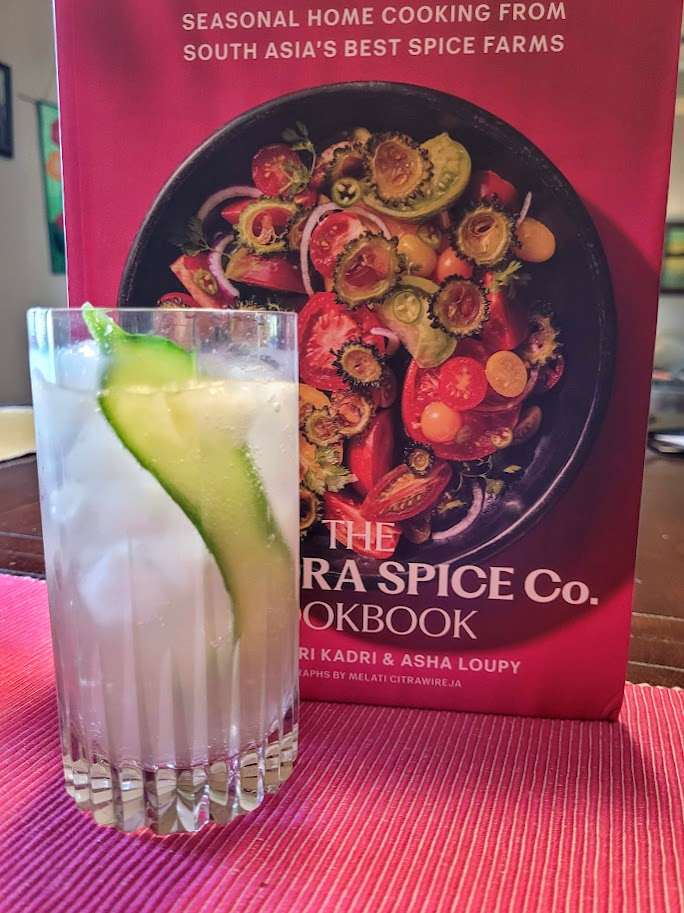
This is delicious and so refreshing. And for a non-alcoholic version, use 1 ounce of fennel shrub with 8 ounces of club soda. Add a cucumber ribbon to this, too.
I’m linking up with Foodies Read for June.